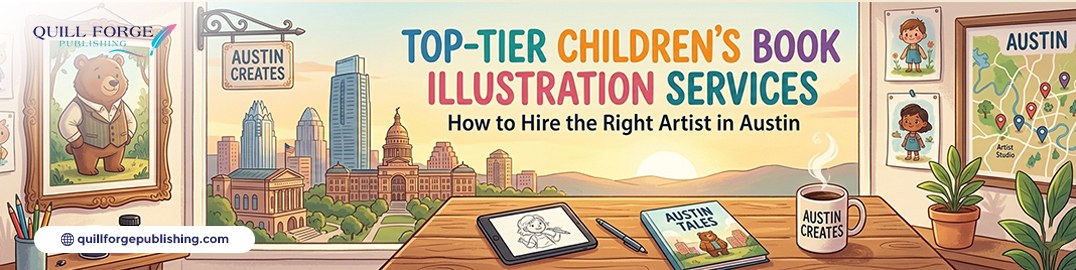
Hiring a professional children's book illustrator in Austin costs between $3,000 and $12,000 for a full 32-page picture book, depending on style complexity. Full spreads run $300–$600 each. You must secure a written "Work for Hire" agreement or full rights transfer — verbal agreements are not enforceable under U.S. copyright law.
If you're searching for children's book illustration services in Austin, you're already ahead of the 73% of first-time authors who hire an illustrator before their manuscript is ready. At Quill Forge Publishing (Balcones Drive, Austin), we've guided over 200 indie authors through our professional children's book publishing services including illustration and editing — since 2018. This guide shares everything we've learned including the costly mistakes we've watched authors make so you don't repeat them.
What Does a Children's Book Illustrator Cost in Austin in 2026?
A standard 32-page picture book illustration project in Austin costs between $3,000 and $12,000 total, depending on illustration style, the artist's experience level, and the number of revision rounds included. Here's how that breaks down by deliverable:
Why the wide range? A simple flat-vector style (think STEM books with bold, clean shapes) costs significantly less than detailed digital oil paintings. In our experience at Quill Forge, most Austin-based authors with a 32-page picture book spend $5,500–$8,000 when working with a mid-career professional illustrator.
Pro tip from Quill Forge team: Don't allocate your full illustration budget at the sketch stage. Release 30% on character sheet approval, 40% on rough sketches, and 30% on final files. This protects you if the creative relationship isn't working.
Which Illustration Style Fits Your Book? (With Real Examples)
The three dominant styles winning shelf space in 2026 are:
Digital watercolor works best for bedtime stories, emotional narratives, and books aimed at ages 0–5. The soft textures signal warmth and safety to parents browsing on Amazon. Austin illustrators like those in our network lean into hand-textured brushwork that feels authentically human rather than AI-generated.
Flat vector / bold design dominates STEM, educational, and concept books for ages 4–8. High contrast makes it readable at thumbnail size — critical for online retail. This style also prints cleanly at low cost, which matters for print-on-demand distribution.
Character-driven comic style suits humorous, adventure, and action-heavy stories for ages 6–12. The expressive linework creates movement on the page, which drives the kind of child-led re-reads that generate word-of-mouth recommendations.
How to Find a Children's Book Illustrator Without Getting Scammed
This is the question we hear most at our Balcones Drive office and for good reason. In 2026, low-cost gig platforms have flooded with illustrators who produce attractive sample art but cannot maintain character consistency across 32 pages. Here's how to protect yourself:
3 Things to Check Before Signing Any Illustrator Contract
1. Request a character sheet before any money changes hands. A character sheet shows your main character from the front, side, and back, plus 3–4 different emotional expressions. If an illustrator can't produce this — or resists the request — they cannot maintain consistency through a full book. This is non-negotiable.
2. Confirming the contract explicitly states "Work for Hire" or "Full Rights Transfer." Under U.S. copyright law, the creator of an illustration owns it by default unless a written contract says otherwise. Many cheap platforms have hidden clauses where the artist retains character rights. At Quill Forge, every illustrator contract we use explicitly transfers 100% of copyright — including the right to make sequels using the same characters — to the author.
3. Ask if bleed and gutters are included in the quote. "Bleed" means the illustration extends 0.125 inches beyond the trim line so there are no white edges after cutting. "Gutters" refer to the centre margin space lost in binding. If your illustrator doesn't know what these are, they haven't produced print-ready files before.
Red Flags to Walk Away From
-
Portfolio shows only standalone characters, never full spreads
-
No mention of print specifications (DPI, colour profile, file format)
-
"Revisions included" without specifying how many rounds
-
Price significantly below $2,500 for a 32-page full-colour book
Professional Book Editing in Austin: Which Type of Editor Does Your Manuscript Actually Need?
Most first-time authors think professional book editing means fixing typos. It doesn't. Sending a grammatically perfect manuscript with a weak structure is like delivering a beautifully painted house with a cracked foundation. Here's the editing ladder — and how to know which rung you're on:
The 4 Levels of Professional Book Editing (In Order)
For a 50,000-word book, expect to spend:
-
Developmental editing: $1,500–$3,000
-
Copy editing: $1,000–$2,000
-
Proofreading: $500–$1,000
Our honest recommendation: If you've never published before, start with a manuscript critique ($300–$500). This gives you professional feedback on whether your manuscript needs a developmental overhaul before you invest in full editing.
Can AI Replace a Professional Book Editor in 2026?
No — and here's specifically why, not just generally why.
AI grammar tools (Grammarly, ProWritingAid, even the latest AI writing assistants) excel at finding comma splices, passive voice overuse, and spelling errors. They cannot do any of the following:
-
Identify when a picture book's page turn falls in the wrong place for emotional impact
-
Tell you that your protagonist's motivation shifts inconsistently between chapters 3 and 7
-
Understand that a phrase that reads as humorous in London reads as rude in Austin
-
Notice that your "surprise" twist is telegraphed four chapters earlier by a clumsy metaphor
-
Know that your target demographic (parents of 4-year-olds) won't read a bedtime story with this pacing
Austin-based editors bring contextual intelligence — knowledge of the local market, the regional voice of Texas-based memoirs, and the cultural nuance that shapes whether a book lands with its intended audience. We've seen authors use AI editing alone and receive feedback from readers that the book "felt mechanical." We've never seen that feedback on a professionally edited manuscript.
How Long Does the Full Illustration + Editing Process Take?
For a print-ready, professionally illustrated and edited children's book, plan for 4–6 months from manuscript to final files. If you want a full roadmap beyond illustration, our guide on how to publish a children's book in the US step by step covers every phase from ISBN registration to retail distribution. Here's a realistic illustration + editing timeline:
-
Weeks 1–2: Manuscript critique + developmental notes
-
Weeks 3–4: Revisions based on developmental feedback
-
Week 5: Final manuscript goes to copy edit and proofreading
-
Weeks 6–8: Illustrator storyboards / dummy book review
-
Weeks 9–16: Illustration rounds (rough sketch → colour roughs → finals)
-
Weeks 17–18: Print file preparation + final proofread of designed pages
-
Weeks 19–20: Upload to distributor, ISBN registration, metadata optimisation
Rushing this timeline especially the illustration rounds is the single most common reason first-time books get 2-star reviews. Parents and children notice inconsistent character design. Reviewers notice rushed backgrounds.
What Is a 32-Page Dummy Book and Why Do You Need One?
A dummy book is a rough physical or digital mock-up showing where text and sketches sit on each of the 32 pages. It serves three critical purposes:
First, it shows you where your page turns fall — the moment a child or parent physically turns a page is a narrative beat, and the best picture books use those beats deliberately (cliff-hangers, reveals, comedic timing).
Second, it reveals text/image conflicts before expensive final illustrations are created. You may discover your 80-word page 12 leaves no room for a meaningful illustration.
Third, it is the document you send to your illustrator as a brief. Without it, the illustrator is guessing about composition and emphasis on every spread.
At Quill Forge, we build dummy books for every picture book client before illustration begins. It saves, on average, 2–3 rounds of costly revision.
Frequently Asked Questions:
1. How do I find a children's book illustrator that fits my story's "voice"?
Start by making a list of 5–10 published picture books whose illustration style feels right for your story. Then search for those illustrators on Instagram or their personal websites many take commissions. For Austin-based talent, reach out to the Austin SCBWI (Society of Children's Book Writers and Illustrators) chapter, which maintains a referral list of vetted local illustrators. When reviewing portfolios, look specifically for: (1) consistency of a single character across multiple poses and emotions, (2) backgrounds that don't flatten or disappear, and (3) evidence they understand print specifications. A beautiful Instagram portfolio does not guarantee print-ready files.
2. Do I own the copyright to my book's illustrations?
Not automatically. Under U.S. copyright law, the illustrator owns the artwork they create unless a written contract explicitly states otherwise. You need either a "Work for Hire" agreement (where copyright transfers at creation) or a full rights assignment document signed by both parties. Do not rely on verbal agreements, emails, or platform terms of service. At Quill Forge, we provide authors with a complete rights transfer contract template as part of our illustration services — 100% of copyright, including sequel rights, transfers to you.
3. What are "art notes" in a picture book manuscript, and how many should I include?
Art notes are parenthetical instructions to the illustrator — for example: [Art note: The dragon is hiding under the bed, though the text doesn't say so]. In 2026, the industry standard is to use art notes only when the visual information is essential to the plot and cannot be inferred from the text. Overusing art notes constrains the illustrator's creativity and often produces stiffer, less dynamic illustrations. A good rule: if a competent illustrator could reasonably figure it out from context, skip the art note.
4. What is the difference between developmental editing and copy editing?
Developmental editing addresses the entire architecture of your book whether the story works, whether characters are compelling, whether the pacing holds a reader's attention, and whether the structure serves your intended audience. It happens first, before you invest in any line-level work. Copy editing is the technical pass that follows: grammar, punctuation, continuity (eye colour doesn't change, character names are spelled consistently), and factual accuracy. Many authors make the expensive mistake of paying for copy editing before getting a developmental edit then having to rewrite large sections, which undoes the copy editing.
5. How much should I budget for the complete publishing process (editing + illustration + printing)?
For a professionally produced 32-page picture book in Austin in 2026, budget the following:
-
Manuscript critique or developmental edit: $500–$3,000
-
Copy editing and proofreading: $800–$2,000
-
Interior illustration (32 pages): $4,000–$10,000
-
Cover design: $600–$1,200
-
Print setup and ISBN registration: $200–$400
-
Total: $6,100–$16,600
If you're working with a tighter budget, read our guide on self-publishing your children's book without spending thousands for smart cost-cutting strategies that don't compromise quality. Print-on-demand through IngramSpark or Amazon KDP adds no upfront cost, but offset printing (for bookstore distribution) requires a minimum print run of 500–1,000 copies at $2,000–$5,000 additional. Before committing to a printer, also compare the best platforms to self-publish your children's book in 2026 to find the right distribution fit for your goals.
6. Should I edit my manuscript myself before hiring a professional editor?
Yes always self-edit first, but do it strategically. Run a pass with a tool like ProWritingAid to catch obvious grammatical issues. Read your manuscript aloud to catch awkward phrasing. Then set it aside for at least two weeks before your professional edit. A professional editor charges by the word and by the complexity of the manuscript — a cleaner draft means they spend time on real structural problems instead of surface-level issues. This saves you money and produces a better outcome.
7. What is a "bleed" in children's book printing, and why does it matter?
Bleed refers to artwork that extends 0.125 inches (3mm) beyond the trim line on all sides. When a printer cuts thousands of books, small variations in the cut line are inevitable. If your illustration stops exactly at the trim line, those variations create thin white borders on some copies. Bleed prevents this by ensuring the artwork extends slightly past where the cut will happen — so even an imperfect cut produces a clean edge. Always confirm your illustrator delivers files at 300 DPI with full bleed included. Files without bleed are rejected by most professional printers.
Ready to Start? Here's What Happens When You Work With Quill Forge
Our Austin-based team on Balcones Drive handles every stage of the children's book production process under one roof:
-
Free 30-minute manuscript assessment — we tell you honestly where your manuscript stands and which services you actually need
-
Illustration matching — we connect you with the right illustrator for your style, budget, and timeline from our vetted network
-
Contract protection — every illustration contract includes full rights transfer and clear revision terms
-
Print-ready delivery — files formatted for IngramSpark, Amazon KDP, and offset printing
[Request your free manuscript assessment →]
Or call our Balcones Drive office directly. We're real people who've read (and written) a lot of children's books.
Quill Forge Publishing | Austin, TX | Balcones Drive | Serving indie authors across Texas and nationwide since 2018