The children's publishing industry known inside the business as "Kidlit" is simultaneously one of the most rewarding and most competitive sectors in all of publishing. In 2026, picture books aren't just books anymore. A strong title can spin off into board book editions, animated streaming series, educational curricula, and licensed merchandise. Agents know this. That's why securing the right representation has never mattered more or required more strategic preparation.
This guide goes beyond the basics. You'll find specific, actionable steps to identify, research, and query children's picture book agents, along with the manuscript standards, platform signals, and regional networking moves that separate debut authors who land deals from those who wait years in the dark.
What Children's Picture Book Agents Actually Do in 2026
Most writers think of a literary agent as someone who submits manuscripts to editors. That's accurate but incomplete. In 2026, a strong Kidlit agent is also:
-
A rights architect who identifies which territories, formats (audio, digital, foreign), and subsidiary markets your book can reach
-
A career strategist who positions your debut as the first book in a long author-publisher relationship
-
A market intelligence source who knows which editors at which imprints are actively acquiring intelligence you cannot access on your own
This distinction matters because it changes who you should query. An agent with five sales to major publishers but no foreign rights experience is a fundamentally different partner than one with a robust sub-agent network in Germany, Japan, and Brazil markets where picture book translation rights are booming.
Understanding the Kidlit Age Category Map
One of the most common reasons queries are rejected before an agent reads a single word is incorrect categorization. Agents specialize. Submitting a chapter book to a picture book agent wastes everyone's time and signals that you haven't done your research.
If your manuscript is 10,000 words, you aren't writing a picture book—you’re likely in the "Chapter Book" or "Middle Grade" category. Agents look for authors who respect these industry standards. For a deeper dive into the technicalities of layout, refer to our guide on The 32 Page Rule for Children’s Picture Books.
Where to Build Your 2026 Agent Target List
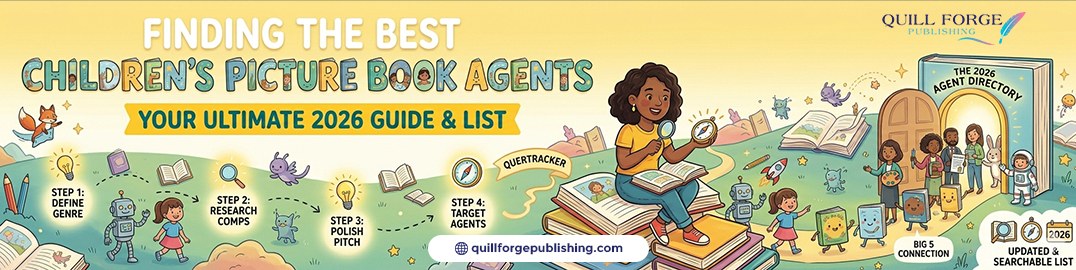
1. QueryTracker (Free and Premium)
QueryTracker is the most data-rich tool available to querying authors. The premium version (approximately $25/year) shows agent response rates, median response times, and the ratio of queries received to full manuscript requests. Filter by "Children's Picture Books" to generate a working list, then sort by "recent activity" to eliminate agents who are closed or slow.
What most guides don't tell you: Cross-reference QueryTracker data with Publisher's Marketplace deal announcements. An agent with strong QueryTracker stats but no recent deals in Publishers Marketplace is a yellow flag.
2. Manuscript Wish List
The #MSWL hashtag on social platforms and the dedicated MSWL.com site publish agent "wish lists" in real time. This is pure competitive advantage. If an agent posts "Desperately seeking a picture book about immigrant family traditions told from the grandchild's POV," and that's your book — you have a warm query instead of a cold one. Check MSWL weekly, not just once.
3. Children's Book Council (CBC) Cross-Reference Method
The CBC publishes member lists of the most reputable US publishers. Go through recent award winners (Caldecott, Geisel, Sibert) and look up which agents represented those authors. These are proven deal-makers. Then check their current agency websites for submission windows.
4. SCBWI — The Network That Opens Doors
The Society of Children's Book Writers and Illustrators remains the single best professional organization for debut Kidlit authors. SCBWI's regional conferences — including active Texas chapters — give you direct access to agents through:
-
Manuscript critiques (paid): Agents read your first pages and give feedback
-
Pitch sessions: Live 10-minute appointments
-
Portfolio showcases: For illustrators, these are career-changing opportunities
For authors in Texas, the Austin writing community is particularly active. Local SCBWI Texas events, Austin-area writing groups, and university extension programs create a regional networking ecosystem that can accelerate your path to representation. At Quill Forge Publishing based in Austin we see this firsthand with the authors we work with every year.
Writing a Query Letter That Gets Read
The picture book query letter is deceptively difficult. You have approximately 300 words to demonstrate professional knowledge of the market, a distinctive authorial voice, and a commercially viable concept simultaneously.
The four-part structure that works:
1. The Personalized Opening (2–3 sentences) Reference something specific about this agent a recent deal, an MSWL post, a panel they spoke at. Generic openings ("I am querying you because you represent children's books") are invisible. Specific openings prove you did your homework.
2. The Pitch Block (3–5 sentences) Include: title, word count, age range, one or two comp titles from the last three years, and your core premise. Lead with what makes your book different, not what it's about. Don't say "this is a story about a bear who learns to share." Say "in the tradition of Bear Wants More, this 500-word picture book follows a bear whose generosity accidentally dismantles the entire forest economy."
3. The Platform Block (2–3 sentences) In 2026, platform matters even in picture books. Teaching credentials, library science background, a strong presence in early childhood education communities, or a social media following in the parenting/literacy space are all legitimate platform signals. If you have none of these, briefly mention your writing community involvement (workshops, critique groups, SCBWI membership).
4. The Professional Close Mention if this is a simultaneous submission (standard and expected). Note if you have other manuscripts ready. Thank them by name. Keep it clean.
2026 Manuscript Standards: The Specifics Agents Check
Before your query goes out, your manuscript must meet these current standards:
-
Word count: Fiction picture books: 300–600 words is the sweet spot. Over 700 words for fiction raises eyebrows. Non-fiction: up to 1,200 words is acceptable with strong justification.
-
Format: 12pt Times New Roman, double-spaced, 1-inch margins, page numbers in header
-
Art notes: Use them sparingly and only when the story is genuinely unclear without them. Format: [Art note: The "monster" is a shadow of a house cat.] Excessive art notes signal you don't trust your illustrator or the agent.
-
Page breaks: Do not include page break suggestions in your manuscript unless the agency guidelines specifically request them.
-
Author-illustrators: Submit a picture book dummy a paginated mock-up with rough sketches and 2–3 finished color spreads. Your dummy is as important as your text. Agents need to see that your visual storytelling and text work together, not in parallel.
What Illustrators Need to Know in 2026
Illustrators querying without an author partner follow a different track entirely. Agents representing illustrators are evaluating:
-
Stylistic range within a consistent voice: Can you draw the same character in 15 different emotional states? Agents need to know you won't paint yourself into a corner mid-project.
-
Sequential storytelling ability: A portfolio of beautiful standalone images is less compelling than a portfolio that shows you can carry a visual narrative across 32 pages.
-
File quality and digital optimization: In 2026, your portfolio must be optimized for both high-resolution print review and mobile viewing. Agents open your portfolio link on their phones constantly.
-
Portfolio hosting: Use a clean, fast-loading platform (Cargo Collective, Format, or a custom site). Behance is acceptable but cluttered. Avoid Google Drive portfolios; they signal a lack of professional investment.
Traditional vs. Self-Publishing in 2026: An Honest Comparison
Not every picture book author needs an agent. Understanding the real trade-offs helps you make a strategic choice rather than a default one.
The honest truth: traditional publishing offers validation and distribution infrastructure that's hard to replicate. Self-publishing offers speed, control, and significantly higher per-unit earnings. Many authors in 2026 are pursuing both — traditionally publishing some titles while self-publishing supplementary or niche projects.
Your Pre-Query Checklist (2026 Edition)
Before you send a single query, confirm every item below:
-
Word count falls within current industry standards for your specific category
-
You have 2–3 comp titles published between 2022–2025 (not classics — recent market comps)
-
Each query letter is personalized with agent-specific research
-
Your manuscript is formatted to current submission standards
-
Your author bio includes any relevant platform, credentials, or community involvement
-
For illustrators: portfolio link is tested on mobile and loads in under 3 seconds
-
For author-illustrators: picture book dummy is complete with 2–3 finished color spreads
-
You have a batch of 5–10 agents queried simultaneously (not one at a time)
-
You have tracked your submissions with a spreadsheet or QueryTracker
Frequently Asked Questions
Do I need an agent to publish a children's picture book?
Only if you're targeting the Big Five (HarperCollins, Penguin Random House, Simon & Schuster, Hachette, Macmillan) or major mid-size publishers. Smaller independent presses and hybrid publishers like Quill Forge accept unagented submissions directly.
How many agents should I query at once?
Send batches of 5–10. This lets you track response patterns and adjust your query letter before exhausting your entire list. Never send 50 queries on day one you can't correct course if something isn't working.
What if I've been querying for over a year with no offers?
Step back and audit three things: your concept (is it commercially distinct?), your query letter (is it compelling?), and your manuscript (does it meet current standards?). Working with a professional book coach before resuming querying is often the most efficient path forward.
Can an agent help with international distribution?
Yes — managing foreign rights is one of the highest-value things an agent does. A good children's book agent will have sub-agents in key markets including the UK, Germany, France, South Korea, and Japan, where picture book translation rights command strong advances.
What's the best resource for finding agents in 2026?
Use QueryTracker for data, MSWL for warm opportunities, CBC member lists for publisher cross-referencing, and SCBWI conferences for direct access. Use all four not just one.
Ready to Publish Your Children's Book — With or Without an Agent?
Whether you're still in the querying trenches or you've decided that traditional gatekeepers aren't the right path for your story, Quill Forge Publishing is built for exactly this moment.
We're an Austin-based publishing house that offers authors something most publishing companies don't: complete creative control, 100% net royalties, and a full-service team that handles everything from professional illustration and editorial to printing, distribution, and book marketing all under one roof.
Our authors don't wait 24 months to see their book in a reader's hands. They don't surrender creative decisions to a publisher who's never met them. And they don't give up the majority of their royalties for the privilege.
If your picture book deserves to exist — and it does — Quill Forge will help you make it real.
Call our Austin team: +1 (214) 506-8395
Email us: info@quillforgepublishing.com
Start Your Publishing Journey at quillforgepublishing.com
Get Your Free Publishing Guide →