Most manuscripts never make it past an agent's desk not because they lack quality, but because the proposal failed. After years of refining your idea and pouring yourself into your writing, the last thing you want is to lose a deal over a preventable structural mistake.
If you are serious about landing a traditional publishing contract in 2026, your manuscript is not the first thing an agent or editor wants to see. They want your book proposal — and they want it done right.
This guide walks you through every section of a winning proposal, what publishers are actually looking for today, and how to avoid the mistakes that get submissions deleted before lunch.
Not sure if traditional publishing is the right path for you? Read our Self-Publishing Checklist to compare the traditional and indie routes before you commit.
What Is a Book Proposal — And Why Do You Need One?
A book proposal is a structured business document that sells the concept of your book to a literary agent or publisher — before the book is even finished.
While fiction writers typically submit a complete manuscript, nonfiction authors use a proposal to pitch the idea, prove the market, and demonstrate that they are the right person to write it. Think of it less like a creative pitch and more like a business plan for your book.
In 2026, publishers are not just buying good ideas. They are investing in brands, platforms, and market potential. A winning proposal does not just say "this is a great book." It says "this book will sell, here is the evidence, and here is exactly how we are going to sell it together."
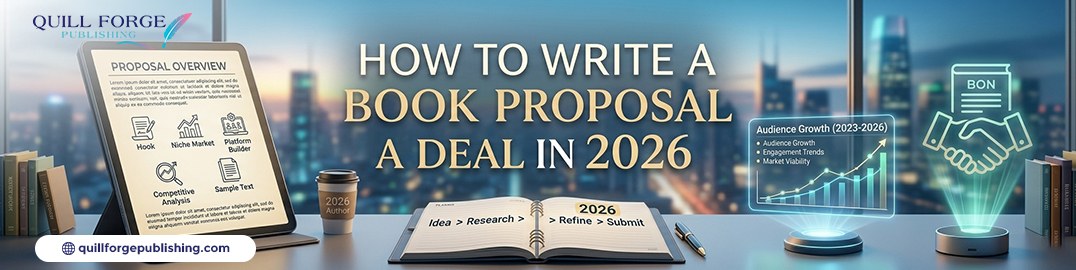
The Essential Book Proposal Template for 2026
A complete, competitive proposal typically runs between 25 and 50 pages and must address both the creative and commercial dimensions of your book. Here is every section you need, in order.
1. The Overview — Your Hook
This is your elevator pitch in written form. In 2 to 3 pages, you need to answer three questions with total clarity:
-
What is this book? Describe the concept, scope, and format in plain language.
-
Why does it need to exist right now? Tie your topic to a current cultural moment, trend, or gap in the market.
-
Why are you the only person who can write it? Establish your unique angle, experience, or authority immediately.
Weak overview: "This book is about productivity for busy professionals."
Strong overview: "While dozens of productivity books target corporate workers, none address the specific psychological and operational challenges faced by first-generation entrepreneurs running sub-five-person teams — a segment that now represents 38% of all US small businesses. This book fills that gap with a system built from ten years of direct coaching experience."
The difference is specificity. Agents read hundreds of overviews each month. Vague language gets skipped. Precise, confident language gets read.
2. Target Audience Demographics
Publishers need to know exactly who will buy this book — and "everyone" is never an acceptable answer.
Provide specific, data-backed audience demographics including:
-
Age range and life stage — Are they college graduates in their late twenties? Retirees entering a new chapter?
-
Income level and purchasing behavior — Do they regularly buy books in this category?
-
Online behavior — Where do they spend time? Are they active on BookTok, LinkedIn, Reddit communities, or niche podcasts?
-
Pain points — What problem are they actively searching for solutions to, and how does your book solve it?
Example: "The primary audience is women aged 35 to 52 with household incomes above $75,000 who are navigating career transitions. This demographic purchases an average of 12 books per year and actively engages with self-development content on Instagram and LinkedIn."
The more precisely you can paint a picture of your reader, the easier it is for a publisher to visualize the customer — and approve the investment.
3. Market Analysis
A professional market analysis shows you understand the publishing landscape, not just your subject matter. This section should demonstrate:
-
Category growth trends — Is your genre or niche expanding? Use data from sources like Amazon Bestseller lists, Google Trends, Publishers Marketplace, or BookScan.
-
Cultural momentum — Is your topic gaining traction on social platforms, in mainstream media, or in academic research?
-
Untapped demand — Where are existing books falling short? What are readers complaining about in one-star reviews of competing titles?
If you have been working through your concept with a professional, our Book Coaching services are specifically designed to help you identify and articulate this market gap with precision — one of the most common areas where proposals fall flat.
4. Competitive Title Analysis — Proving Your Unique Selling Point
This is often the most scrutinized section of any proposal, and it is where many authors make critical errors.
You must identify 5 to 7 books published within the last 3 to 5 years that occupy similar territory to yours. For each title, provide:
-
Full title, author, publisher, and publication year
-
A brief summary of the book's approach and audience
-
A clear explanation of how your book differs, complements, or improves upon it
The golden rule of competitive analysis:
Do not say your book has no competition — this signals to a publisher that there is no proven market. Do not say your book is "just like" a bestseller — this signals that you have nothing new to offer. The goal is to prove that readers are already spending money in this space, and that your book provides the missing piece they have been searching for.
Example framing: "While James Clear's Atomic Habits addresses habit formation broadly, it does not speak to the specific context of creative freelancers whose income instability creates unique psychological barriers to consistency. This book fills that gap directly."
5. Author Biography and Platform — Your Sellability
In 2026, your author biography and platform section carries as much weight as your writing quality. Publishers want to see what they are sometimes calling an "unfair advantage" — a built-in audience, a credible voice, or an established reach that reduces their marketing risk.
Your platform snapshot should include:
-
Social media following — Total followers across platforms, with engagement rates where strong
-
Email list — Subscriber count and average open rate
-
Podcast or media presence — Any shows you host or appear on regularly, with listener numbers
-
Speaking engagements — Conferences, workshops, corporate events, or universities
-
Professional credentials — Degrees, certifications, industry positions, or notable clients
-
Press mentions — Any coverage in recognized publications, even regional ones
If your writing expertise does not yet match your professional authority — for example, you are a highly credentialed expert but not a natural writer — our Professional Ghostwriting services ensure your proposal and sample chapters reflect the level of quality your platform promises. Many successful nonfiction authors work with ghostwriters without ever disclosing it, and doing so is entirely standard in the industry.
6. Chapter Outline
The chapter outline gives agents and publishers a structural map of your entire book. It should include:
-
Every chapter title
-
A paragraph of 100 to 150 words per chapter summarizing the key argument, story, or information covered
-
Any subsections, case studies, or exercises included in that chapter
This section proves you have thought beyond the concept. A well-structured outline signals that you can actually deliver the book and that the content will hold up across a full-length manuscript.
Common mistake: Listing chapter titles without descriptions. A title like "Chapter 4: The Turning Point" tells an agent nothing. Describe what the chapter actually contains.
7. Sample Chapters
Most proposals require 2 to 3 fully polished sample chapters — typically the introduction and one or two of the strongest content chapters. These chapters must represent the quality of your final manuscript, not a rough draft.
This is where many proposals lose deals that the rest of the document had nearly won. If your sample chapters are unpolished, inconsistent in voice, or structurally weak, no amount of strong market analysis will save the submission.
Our Professional Editing services are specifically built for authors at this stage — line editing, developmental feedback, and proofreading to ensure your sample chapters are genuinely ready for an agent's desk.
8. The Book Marketing Plan — Your Promise to Sell
Publishers today expect authors to shoulder a significant portion of their own book promotion. Your marketing plan is your written commitment to do exactly that — and vague promises will not be taken seriously.
A strong book marketing plan includes:
-
Email list and newsletter strategy — Exact subscriber count, planned launch announcements, and ongoing content schedule
-
Social media campaigns — Specific platforms, planned content formats, and any paid promotion budget
-
Podcast tour — Confirmed or targeted podcast appearances with estimated audience reach
-
Speaking and events — Booked or planned engagements where you will promote the book
-
Influencer and media relationships — Any direct access to publicists, journalists, or influencers in your niche
-
BookTok and community strategy — If relevant to your genre, your plan for reaching the reading communities on TikTok, Instagram, and Goodreads
Weak plan: "I plan to promote the book on social media and through my network."
Strong plan: "I will announce the book to my 47,000 newsletter subscribers with a four-week pre-launch sequence. I have confirmed appearances on six podcasts with a combined audience of 320,000 listeners. I will host a virtual launch event and partner with three aligned brands for co-promotion."
Concrete numbers win. If your marketing strategy needs development, our Marketing and Publicity services can help you build a launch plan that publishers will find genuinely compelling.
Common Proposal Mistakes That Get You Rejected
Even strong writers make these errors. Avoid them entirely:
1. Writing the proposal like a book jacket. Your overview is a business pitch, not a back-cover blurb. Lead with market need, not atmosphere.
2. Skipping the competitive analysis. Some authors omit this section because they fear their competition. Agents see the omission as laziness or ignorance either is equally damaging.
3. Understating your platform. If you have 5,000 highly engaged newsletter subscribers in a niche market, that is valuable. Do not leave it out because the number feels small.
4. Submitting unpolished sample chapters. Your proposal can be perfect and your sample chapters can still kill the deal. Have them professionally edited before submission.
5. Proposing a book with no clear end reader. "People who like to read" is not a target audience. Go back to section two and get specific.
6. Making promises you cannot keep in the marketing plan. Agents and editors remember what authors commit to. Only include what you can realistically deliver.
What Happens After You Submit
Understanding the submission process helps you set realistic expectations and avoid follow-up mistakes.
In most cases, you do not pitch publishers directly. You submit your proposal to a literary agent who evaluates it, requests revisions if interested, and then pitches it to publishers on your behalf. The agent works on commission typically 15% of your advance and royalties so they are motivated to place books they genuinely believe in.
After submission, response times vary widely. Some agents respond within four to six weeks. Others may take six months or more or never respond at all, which in the industry is often considered a silent rejection.
If your proposal is rejected, it does not mean your book has no future. Many successful authors use their proposal as a detailed blueprint for a self-publishing launch — and in many cases, a self-published book with strong sales becomes the leverage needed to secure a traditional deal later. Read our comparison of Hybrid Publishing vs Self-Publishing to understand all your options.
Proposal Checklist: Everything You Need Before You Submit
Use this as your final review before sending:
-
Overview — 2 to 3 pages, clear hook, market need, and author authority established
-
Target audience — specific demographics with supporting data
-
Market analysis — category trends, cultural momentum, and demand evidence
-
Competitive title analysis — 5 to 7 titles with clear differentiation explained
-
Author bio and platform — all reach metrics included, credentials listed
-
Chapter outline — every chapter summarized in 100 to 150 words
-
Sample chapters — 2 to 3 chapters, professionally edited and proofread
-
Marketing plan — concrete numbers, confirmed engagements, specific platforms
-
Formatting — consistent font, clean layout, page numbers, and your contact information on every page
Ready to Build Your Proposal With Professional Support?
A book proposal is one of the most important documents you will ever write — and getting it right the first time dramatically improves your odds of landing the deal you have worked toward.
At Quill Forge Publishing, our Austin-based team works with authors at every stage of the proposal process — from early concept development through final polish. Whether you need Book Coaching to sharpen your market positioning, Ghostwriting support to elevate your sample chapters, or Professional Editing to ensure every page is submission-ready, we are here to help you move forward with confidence.
Contact Quill Forge Publishing today to schedule your proposal review. Visit us at 5900 Balcones Drive, Austin, TX or reach out at info@quillforgepublishing.com
Frequently Asked Questions
What should a nonfiction book proposal template include?
A complete nonfiction proposal includes an overview, target audience demographics, market analysis, competitive title analysis, author biography and platform, chapter outline, 2 to 3 sample chapters, and a book marketing plan.
How long should a book proposal be?
Most competitive proposals run between 25 and 50 pages, not including sample chapters. Shorter proposals risk appearing underdeveloped. Longer proposals should only exceed 50 pages if every section genuinely earns its length.
How do I conduct a market analysis for my proposal?
Start with Amazon Bestseller lists and Google Trends to identify category growth. Cross-reference with Publishers Marketplace for recent deal activity in your genre. Identify the gaps that reader reviews of competing titles consistently highlight.
What are publishers looking for in target audience demographics?
Specificity and data. Age range, income level, online behavior, and the specific problem your book solves for them. The more precisely you define your reader, the more confident a publisher feels about the commercial potential.
How long does a competitive title analysis take to write?
Plan for one to two weeks of genuine research. Read the competing books or at minimum, thoroughly review their contents, reader reviews, and sales performance before writing your analysis.
How much does it cost to write a book proposal?
If written independently, the cost is your time. If you work with a ghostwriter or book coach to develop it, costs vary based on the scope of support. Contact us directly for a quote tailored to your project.
How long does it take to write a book proposal?
For a well-researched, polished proposal, plan for six to twelve weeks if writing independently. Working with a coach or professional writing team can compress that timeline significantly.
Do I need a finished manuscript before writing a proposal?
For nonfiction, no. You need the proposal and 2 to 3 polished sample chapters. For fiction, you typically need the complete manuscript before approaching agents.
Can I self-publish if my proposal is rejected?
Absolutely and many authors do exactly that. A strong proposal functions as an excellent blueprint for a self-publishing launch. Explore our guide to Hybrid Publishing vs Self-Publishing to find the right path forward.
How can a book coach help with my proposal?
A coach helps you sharpen your hook, pressure-test your market analysis, and ensure your competitive title section is rigorous enough to hold up under an agent's scrutiny. Learn more about our Book Coaching services.
The Editorial Team at Quill Forge Publishing works with authors across the US and internationally to help bring their stories and ideas to market. Based in Austin, Texas, Quill Forge offers ghostwriting, editing, book coaching, design, distribution, audiobook production, and marketing services all under one roof.